TRND launch pending. Fund A’s initial $1 million is funded and live at Interactive Brokers as of October 16, 2026. Trading is paused until the first TRND buyback.
An operating business.
A new token economy.
TrendTrader Pro is a profitable trading software business with an operating product, customers and subscription revenue. Our proprietary algorithm follows the market-maker cycle and delivers algorithmic trades across global markets.
TRND connects Fund A’s realized trading profits to open-market purchases and permanent burns. The operating software business provides the research and product foundation behind that strategy.
TrendTrader Pro’s operating software.
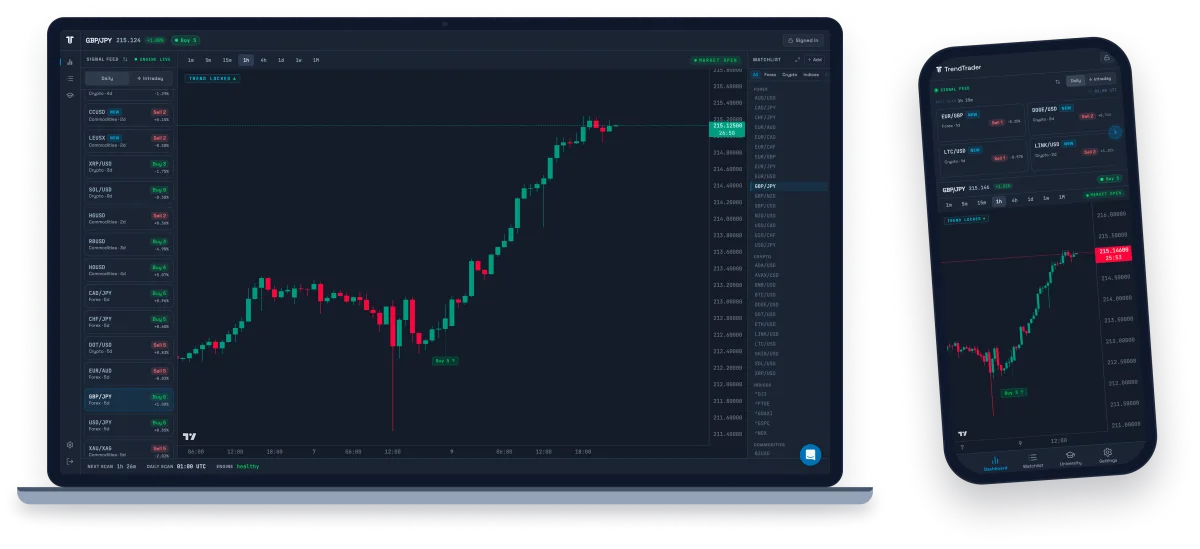
Software first
Operating product and customers
$1 million
Fund A · initial raise closed
TRND only
Fund A purchases and burns
The case for holding TRND.
Fund A brings trading profits to the token market. Its policy commits 50% of available realized trading profits to buying TRND and permanently burning every token purchased with that allocation.
- Fund A profits
 Buy TRND
- Burn acquired tokens
What holding TRND means
You hold the TrendTrader Pro token: a finite asset whose initial supply is 1 billion tokens. The company buys tokens from the market with its profit-funded allocation, then removes those tokens from supply. Your token count stays the same while your share of the remaining supply increases with completed burns.
The holder thesis is that repeated purchases can create demand while burns reduce supply. Fund A has reported $44,498.74 in realized trading profit, with $22,249.37 ready for the first buyback. That is the starting point for proving the model through execution and published records.
Future growth depends on trading results, effective execution and continued demand for TRND. Holding TRND does not grant company equity or a right to profit distributions. Buybacks and burns do not guarantee appreciation.
Launch and supply.
TrendTrader (TRND) launches on Solana through pump.fun. Initial supply: 1,000,000,000 tokens. Fund A’s buyback and burn targets TRND.
Fund A’s trading strategy.
Fund A is TrendTrader Pro’s private hedge fund, focused exclusively on futures trading. Its initial $1 million raise from private angels is closed, and the capital is funded and live at Interactive Brokers. Fund A trades gold futures (GC1!), crude oil futures (CL1!), Nasdaq-100 futures (NQ1!) and S&P 500 futures (ES1!) using company capital, with planned risk of 1% of current equity per trade. Trading is currently paused until the first TRND buyback.
The initial $1 million is the starting point for proving the model: trading, distributions, buybacks and burns. Once that cycle is operating end to end, our medium-term priority is to raise additional capital to grow Fund A’s assets under management. The amount to be raised remains to be determined.
 Gold Futures (GC1!)Precious metal
 Crude Oil Futures (CL1!)Energy
 Nasdaq-100 Futures (NQ1!)Equity index
 S&P 500 Futures (ES1!)Equity index
The TRND economic flywheel
Fund A modelthen burn
Fund A capital
Initial $1 million funded at Interactive Brokers. Trading is paused until the first TRND buyback.
Strategy execution
Trade the four futures markets above with 1% planned equity risk per trade, within portfolio limits.
Available profits
50% funds open-market TRND purchases. Burn every token acquired with that allocation.
The business half
Retain capital, pay Fund A investors and build a held TRND treasury. Management sets the mix.
Fund A’s reported results.
Fund A reports $44,498.74 in realized trading profit through Nov 3, 2026, a +4.4% return on its $1,000,000 initial capital. These are live-trading results reported by the company, not a backtest or an annualized return.
- Realized trading profit
- +$44,498.74
- Return on initial capital
- +4.4%
- 50% buyback allocation
- $22,249.37
Trading is paused until the first TRND buyback. $22,249.37 is ready for that purchase, targeting one transaction within about an hour of the $1.28M market-cap trigger. The threshold is selected to limit slippage. Purchase and burn remain pending.
Inspect Fund A’s results and trade recordsPosition sizing and retained capital.
Fund A’s planned risk budget is 1% of current equity per trade, within portfolio and execution limits. Retained profits add to trading capital; losses and distributions reduce it. The business allocation supports Fund A capital, investor distributions and a held TRND treasury.
Fund A’s buyback and burn targets TRND from the first distribution.
50% for purchases and burns.
50% for the business.
Under the policy, 50% of Fund A’s available realized trading profits is directed to open-market TRND purchases. Every token bought with that allocation is burned. The other 50% is the business allocation: it compounds inside Fund A, pays the distributions to the investors whose capital is behind Fund A, and builds a company treasury of TRND.
The current profit allocation
Reported results- TRND purchases & burns
- 50%
- $22,249.37 · burn every token purchased
- Business allocation
- 50%
- $22,249.37 · retained capital, investors and treasury
The business half.
Management divides the other 50% between retained Fund A capital, distributions to its private investors and open-market purchases for a company TRND treasury. The mix is discretionary; investor terms are private.
Treasury tokens are held, not burned. Treasury purchases do not reduce the separate 50% purchase-and-burn allocation. Holdings can gain or lose value. No treasury purchase has been made yet; purchases, sales and balances will have their own reporting.
How a market purchase and burn work
Open-market purchases create demand for TRND. Burning the purchased tokens permanently reduces total supply. A burn does not itself change pool reserves; the market price still depends on liquidity, buying and selling.
Open-market purchases, sized to liquidity.
The purchase allocation does not have to be spent in one transaction. Management may split it into smaller open-market purchases, choosing size and timing based on available liquidity, quoted price impact, slippage, fees and operational readiness. Staging purchases allows conditions to be reassessed between orders; it does not guarantee a better overall price or eliminate execution costs.
Price impact
The change caused by the purchase itself as it uses available liquidity. A larger purchase relative to liquidity generally has more impact, which is already reflected in the quote.
Slippage
The difference between the quoted result and actual execution as market conditions change. Slippage tolerance limits deviation from the quote; it does not remove the price impact already in it.
Both can affect a purchase, and fees are separate costs. Merely splitting consecutive buys in the same unchanged pool does not create better aggregate pricing. Execution depends on the liquidity and prices available when each order is placed.
Swap mechanics: Uniswap: price impact and slippage · Jupiter: swap execution .
Allocation, timing and reporting.
Management chooses the timing of distributions around open positions, trading liquidity and operational readiness. Purchase timing and order size remain discretionary without changing the 50% allocation. Every TRND bought with that allocation is burned. Fund A is currently paused until the first buyback; the current plan and reported profit are published in the Fund A update. Reporting will distinguish amounts allocated from purchases and burns completed.
The operating policy will define deductible costs, prior-loss treatment, measurement periods and allocation authority before the first allocation. Unrealized gains do not fund the policy.
Each completed purchase and burn will have a transaction record. Burn reporting will identify the method and verified supply effect. Treasury purchases, sales and balances will be recorded separately.
The policy uses Fund A’s available realized trading profits. It does not allocate creator fees.
Make the activity inspectable.
Fund A’s reported results and trade records are published on the Fund A dashboard. The first TRND purchase and burn are still pending. Completed activity will link realized profits to allocations, transfers, purchases and burn transactions; company treasury activity will be reported separately.
Follow the evidence
Distribution record
Trading statement · Capital, closed P&L, costs and prior losses
Purchase transaction
TRND acquired · Execution record
Burn transaction
Supply reduction · Verified burn record
6Hm5z3D5LMRhUYPfZ9eKMfS2J6RPQkr73vnQrTm7owdNPublished on the Fund A dashboard. One wallet for both the buyback and the burn.
View Fund A dashboardThe $TRND buyback and burn wallet is published on the Fund A dashboard; the reporting method and cadence follow with the first report. On-chain transactions provide one part of that record; performance reporting will also account for execution, costs and balances held at trading venues.
Short, medium and long term.
Execution first. Then growth.
Complete the first buyback and burn.
Fund A has $22,249.37 ready. Target the $1.28M market-cap trigger, execute the purchase, burn the acquired tokens and publish the records. Trading remains paused until the first buyback.
Grow capital and trading access.
Once the model operates end to end, raise additional Fund A capital; the amount is undecided. Pursue selected exchange listings and explore a market-maker relationship. Build the company TRND treasury from the business half and expand software adoption.
Improve Fund A’s operation.
Advance trading research, execution and reporting. Keep the connection between realized profits, purchases and burns inspectable.
We aim to grow Fund A’s assets under management through additional capital raising once the model is operating end to end, alongside wider access through trading apps and selected centralized exchanges. The horizons above set out the full roadmap. Find current verified buying routes on the TRND overview.
Where TRND stands today.
- TRND
- Company token
- Fund A’s buyback-and-burn target.
- Fund A
- $1M
- Initial raise closed
Live at Interactive Brokers
We never ask for a seed phrase. This website has no wallet connection, claim facility or deposit interface.
Contract & buying informationHow market figures are calculated.
The TRND market provides Jupiter data once the mint is published of price, market cap, liquidity and holders. Detailed charts, pool coverage and recent trades await the pool feed connection. The calculation methods for that feed are documented below.
Price, change and valuation
The market feed uses Jupiter Tokens API v2 for price, market cap, holders and liquidity. Once the pool feed is connected, the current price will be the TRND/SOL PumpSwap reference price in USD. Period change compares it with the last PumpSwap execution at or before the period start. FDV is price multiplied by current total supply after burns; it is not independently verified circulating market cap.
Volume and chart history
Volume and trade activity combine tracked pools, count each swap once and exclude swap fees. Historical USD values use the corresponding historical quote-token price. The chart shows five-minute executed-trade candles; the line connects their closing prices.
Liquidity and venue coverage
Liquidity values actual pool balances at consistent reference prices, excludes virtual reserves and may include liquidity outside the current trading range. Pools with an unpriced quote asset remain visible but are excluded from the displayed valued-liquidity subtotal. Discovery covers PumpSwap, Meteora DLMM and Meteora DAMM v2; additional venues require verification.
Data availability
Missing history remains unavailable. Quiet markets can have a healthy feed without a recent trade.
Once connected, the detailed pool feed uses Helius , with Pyth SOL/USD when verified and fresh. USD trade history and fallback quotes use Kraken . Attribution, coverage and data status remain beside the live market.
View the TRND marketQuestions about TRND.
What is the case for holding TRND?
TRND is the TrendTrader Pro token, with a fixed initial supply of 1 billion. Fund A allocates 50% of available realized trading profits to buying TRND on the open market, then permanently burns every token purchased with that allocation. Holders are backing a model that connects trading performance to token demand and a shrinking supply. Its success depends on profitable trading, execution and continued market demand.
How does the buyback and burn work?
Fund A realizes trading profits, allocates 50% of the available amount to TRND purchases and executes those purchases on the open market. The company then burns 100% of the tokens bought with that allocation. Future profitable periods can fund further purchases and burns. Each completed purchase and burn will have a transaction record on the Fund A dashboard.
What has Fund A earned so far?
Fund A reports $44,498.74 in realized trading profit through Nov 3, 2026, a +4.4% return on its $1,000,000 initial capital. The 50% buyback allocation is $22,249.37. These are company-reported live-trading results for that period, not an annualized return. Inspect the results and trade records; the first TRND purchase and burn remain pending.
When will the first buyback happen?
$22,249.37 is ready. The target is one transaction within about an hour of TRND reaching the $1.28M market-cap trigger. The threshold is designed to limit execution costs so more of the allocation buys tokens for burning. Fund A has paused trading until this first buyback. The trigger is an execution target; market cap alone does not establish the liquidity available for an order.
How does burning affect my tokens and the supply?
The company burns tokens it purchases, not tokens in your wallet. Your token count stays the same. Each completed burn removes acquired tokens from total supply, so the same holding represents a larger share of the remaining supply. TRND’s initial issuance is 1 billion tokens; current supply and completed burns must be verified on-chain.
Do buybacks and burns guarantee a higher price?
Buybacks add buying demand; burns permanently reduce token supply. That is the economic case. A burn itself does not change a liquidity pool’s reserves or set a price floor. Other buyers and sellers, available liquidity and Fund A’s results still matter. TRND can lose value, including after a buyback.
What could support a $10M market cap or more?
Our ambition is to grow TRND through a working buyback-and-burn model, transparent results and wider market access. Growing Fund A’s capital could increase its capacity to generate profits and fund purchases, if its trading remains profitable. Repeated execution and published transaction records would give holders evidence to assess. A $10M market cap is an ambition, not a forecast, commitment or guaranteed outcome.
Where does the other 50% go?
The business allocation has three uses: retain capital in Fund A, pay distributions to Fund A’s private investors and buy TRND for a company treasury. Management sets the mix. Treasury tokens are held, not burned, and those purchases do not reduce the separate 50% purchase-and-burn allocation.
Where can I verify the token and the buybacks?
Start with the contract address and platform links in Buy & track TRND. Check that the address matches before using a trading venue. The Fund A dashboard publishes the fund record and will link completed purchases and burns. Pending links or allocations are not completed activity.
Does holding TRND give me ownership of Fund A?
Holding TRND does not grant company equity or a right to profit distributions. You own the tokens in your wallet. Fund A connects its available realized profits to TRND through open-market purchases and burns; holding the token does not make you a Fund A investor or give you a claim on its assets.
What happens if Fund A has a losing period?
Trading losses reduce Fund A’s capital and can reduce or delay future buybacks. No available realized profit means no profit-funded buyback for that period. The policy uses available realized profits, not a fixed payment or guaranteed purchase schedule. Allocation and completed execution will be reported separately.
Can I pay for software subscriptions with TRND?
Software subscriptions continue through our existing checkout. TRND’s current use centers on Fund A’s purchase-and-burn policy.