
TTPRO is live. Fund A’s initial $1 million is funded and live at Interactive Brokers as of October 16, 2026. Fund B is in development; deposits are not open.
An operating business.
A new token economy.
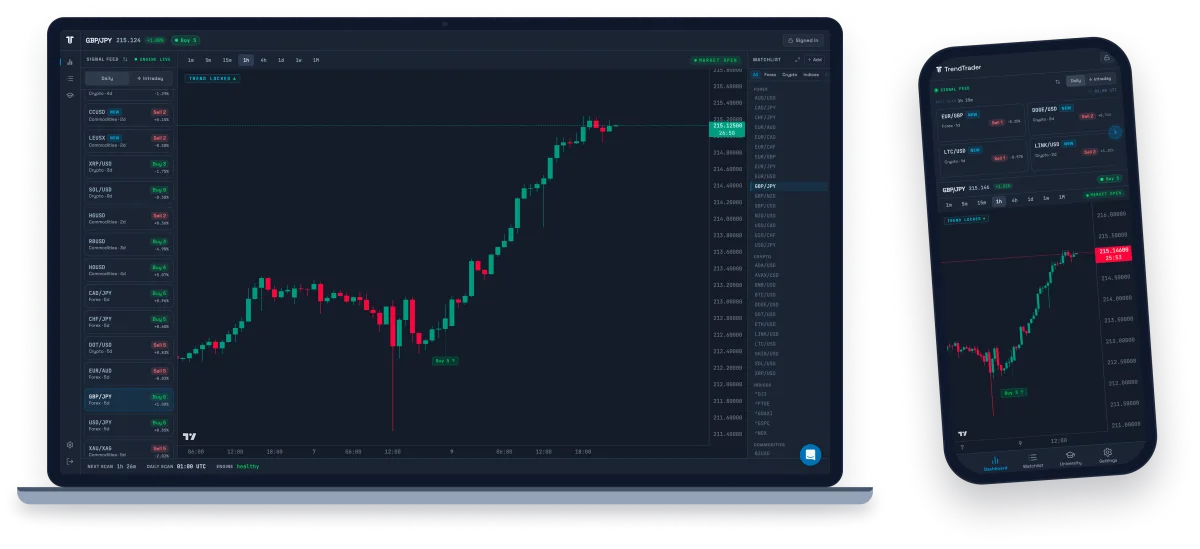
TrendTrader Pro is a profitable trading software business with an operating product, customers and subscription revenue. Our proprietary algorithm follows the market-maker cycle and delivers algorithmic trades across more than 1,000 markets.
TTPRO connects two parts of our fund strategy: profit-funded market purchases and burns from Fund A, and TTPRO-only participation in Fund B, our separately developed participant fund. The operating software business provides the research and product foundation behind that strategy.
TrendTrader Pro’s operating software.
Software first
Operating product and customers
$1 million
Fund A · initial raise closed
TTPRO only
Planned Fund B entry and settlement
The goal of TTPRO is twofold.
- Profit
 Buy TTPRO
- Burn
Connect trading profits to TTPRO purchases and burns.
Fund A’s policy directs 50% of available realized profits to open-market purchases of TTPRO and burns every token bought with that allocation.
- TTPRO
- Fund B
- TTPRO
Make TTPRO the route into Fund B.
Fund B would be open exclusively to eligible TTPRO holders, using TTPRO to allocate capital and receive settlements.
The first mechanism concerns Fund A’s profits; the second concerns participant capital under separate fund terms.
What holding TTPRO means
Holding TTPRO does not grant company equity or a right to profit distributions. Participation in Fund B would require eligibility and a separate TTPRO allocation under Fund B’s terms.
Software subscription payments
Software subscriptions continue through our existing checkout. The TTPRO utility focuses on Fund A’s purchase-and-burn policy and planned Fund B participation.
Launch and supply.
TTPRO has a fixed initial supply of 1,000,000,000 tokens on Solana through Pump.fun. Fund A buys TTPRO on the open market during the migration window. Existing TTP converts at a $300,000 valuation using the daily published rate. Deposited TTP is burned at close.
Find the current contract and buying routes in Buy & track TTPRO.
TTP → TTPRO migration
Migration opens Nov 4, 5:00 AM ET
Every TTP converts at a $300,000 valuation. Paid in TTPRO at a daily published rate.
- Valuation
- $300,000
- about double where TTP traded on launch day.
- Daily rate
- 5:00 AM ET
- Opening rate, then every day at 9:00 AM ET. TTPRO per TTP.
- Window
- Nov 4 – 11
- Nov 4, 5:00 AM ET to Nov 11, 2:00 AM ET
- Your TTP
- burned at close
- Fund A buys the TTPRO on the open market, no pre-mined pool, no team wallet holding your tokens.
Calculate your conversion
- Dollar value
- $0.000307 per TTP
- TTPRO out
How to migrate
Connect your wallet from 5:00 AM ET
Phantom, Solflare or Jupiter. Open the migration dashboard.
Enter your TTP amount
Review the dollar value and TTPRO at today's rate.
Confirm the transaction
The company sends TTPRO from the Fund A wallet within 24 hours; deposited TTP is burned at close.
Window closes Nov 11, 2026, 2:00 AM ET / Nov 11, 2026, 7:00 AM UTC.
Migration questions
Why relaunch?
The founder explains the relaunch, the migration and what comes next in his relaunch video. Every TTP holder converts to TTPRO at the published valuation.
Why not 1:1?
Supply is fixed at 1 billion on pump.fun, so instead of a token ratio every TTP is converted at a fixed dollar valuation and paid in TTPRO bought on the open market.
What happens if I miss the window?
Migration closes Nov 11, 2:00 AM ET. Late deposits are not accepted. Deposited TTP is burned at close.
What happens to Fund A buyback-and-burn?
It moves to TTPRO from the first distribution.
Is the old token still tradable?
Yes, on PumpSwap. Legacy TTP is no longer supported or verified going forward.
Fund A is live.
Fund A is TrendTrader Pro’s private hedge fund, focused exclusively on futures trading. Its initial $1 million raise from private angels is closed, and the capital is funded and live at Interactive Brokers. Fund A trades gold futures (GC1!), crude oil futures (CL1!), Nasdaq-100 futures (NQ1!) and S&P 500 futures (ES1!) using company capital, with planned risk of 1% of current equity per trade. Trades execute when the algorithm fires a setup.
The initial $1 million is the starting point for proving the model: trading, distributions, buybacks and burns. Once that cycle is operating end to end, our medium-term priority is to raise additional capital to grow Fund A’s assets under management. The amount to be raised remains to be determined.
 Gold Futures (GC1!)Precious metal
 Crude Oil Futures (CL1!)Energy
 Nasdaq-100 Futures (NQ1!)Equity index
 S&P 500 Futures (ES1!)Equity index
The TTPRO economic flywheel
Fund A modelthen burn
Fund A capital
TrendTrader Pro’s initial $1 million in trading capital. The raise is closed and the capital is live at Interactive Brokers.
Strategy execution
Trade gold futures (GC1!), crude oil futures (CL1!), Nasdaq-100 futures (NQ1!) and S&P 500 futures (ES1!) with 1% planned equity risk per trade, subject to portfolio and execution limits.
Available profits
Allocate 50% of available realized profits to open-market TTPRO purchases, sized to liquidity, and burn every token bought with that allocation. Accounting rules remain to be finalized.
The business half
The business half compounds in Fund A, pays the investor distributions and builds a company TTPRO treasury. Retained profits increase trading equity and the dollar budget under the 1% risk rule.
Historical research and its assumptions
Our 2020–2026 Performance Report documents company-reported historical backtesting from January 1, 2020 through September 11, 2026. It examines daily and intraday algorithmic trades, including results, drawdowns, recorded trading costs and methodology.
Annual net trading P&L
Published historical backtest- Initial capital
- $100,000
- Ending closed balance
- $1,038,260.96
The published research
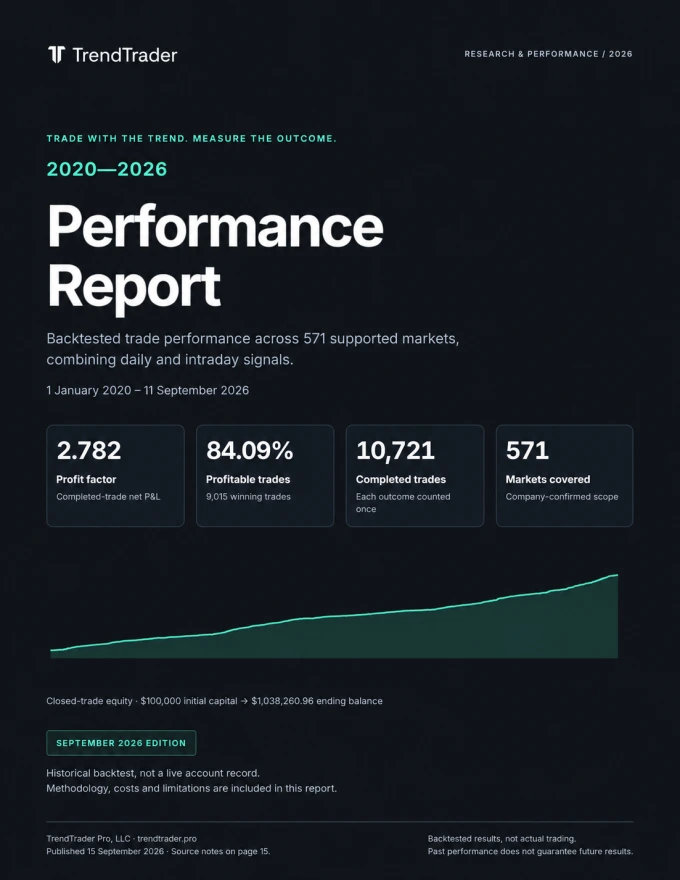
- Profitable trades
- 84.09%
- Headline accuracy
- Profit factor
- 2.782
- Completed-trade net P&L
- Completed trades
- 10,721
- Daily and intraday
- Backtest period
- 2020–2026
- January 1, 2020–September 11, 2026
Two different sizing approaches
The published backtest
- Starting capital
- $100,000
- Position size
- One contract, fixed
- What grows
- Balance only
- Status
- Published historical test
Fund A
- Starting capital
- $1 million
- Position size
- 1% of current equity
- What grows
- Balance and position size
- Status
- Funded and live at Interactive Brokers
1% planned risk. A changing dollar budget.
Illustrative sizingThese example account balances show how the sizing rule responds to both growth and losses. They are not performance targets or a time series.
Each risk budget = account equity × 1%. Bars compare the dollar risk budgets.
A 10% profit. Two equal allocations.
Illustrative example$50,000 buys TTPRO on the open market
Every TTPRO purchased with this allocation is burned.
$50,000 business half
If the full business half is retained in that period, trading equity becomes $1,050,000 — a 5% increase after the purchase allocation.
Planned risk: 1% of equity.
The planned dollar budget rises with retained equity.
- Before $10,000
- After $10,500 +5%
One allocation. Purchases sized to the market.
The $50,000 purchase allocation can be divided into smaller open-market orders. Management chooses the number, size and timing based on available liquidity, price impact, slippage and fees.
- Order 1$10,000
- Order 2$10,000
- Order 3$10,000
- Order 4$10,000
- Order 5$10,000
Example only, not a fixed order size, timetable or commitment. Splitting a purchase does not guarantee less price impact or slippage. Read how execution works.
- Open-market buys
- TTPRO acquired
- 100% burned
The number of TTPRO acquired depends on actual execution prices and costs. Burning those purchased tokens reduces supply; it does not by itself change pool reserves or guarantee a higher token price.
Position sizing and retained capital.
Fund A’s planned risk budget is 1% of current equity per trade, within portfolio and execution limits. Profits retained in the trading account add to the capital available for subsequent trades. The 50% business allocation may be retained in the account, distributed to the investors behind Fund A or used for treasury purchases; the other 50% funds TTPRO purchases and burns. Losses and distributions reduce trading equity and the next position’s risk budget.
Sizing methodology for Fund A
The original 10,721 completed trades reconcile to the published $938,260.96 net profit. The exported ledger does not provide each trade’s initial stop price, so it cannot establish the risk-based position size for a new replay.
The planned 1% risk rule and the 50/50 profit allocation are established. A Fund A simulation still needs trade-level initial stops, precise distribution timing, costs, margin and execution limits. Simply multiplying historical trades by a growing balance assumes those constraints away. The fixed-contract study and a risk-based Fund A simulation measure different approaches.
Fund A buyback-and-burn moves to TTPRO from the first distribution. The 23.9 million legacy TTP burn remains part of the historical record.
50% for purchases and burns.
50% for the business.
Under the policy, 50% of Fund A’s available realized trading profits is directed to open-market TTPRO purchases. Every token bought with that allocation is burned. The other 50% is the business allocation: it compounds inside Fund A, pays the distributions to the investors whose capital is behind Fund A, and builds a company treasury of TTPRO.
Where the trading profits go
Illustrative example- Market purchases & burns
- 50%
- $50,000 · every token bought is burned
- Business allocation
- 50%
- $50,000 · compounds, pays investors, builds a held treasury
Purchase and burn
Buy TTPRO on the open market, in one or more purchases sized to available liquidity, then burn 100% of those purchased tokens.
Compound, pay investors, build a treasury
The business half compounds in Fund A, pays the distributions to the investors whose capital is behind Fund A, and buys TTPRO on the open market for a company treasury. Treasury tokens are held, not burned.
How TrendTrader Pro benefits: the business half.
The other 50% belongs to the business allocation, and it has three jobs. It is retained inside Fund A, increasing trading equity. It pays the distributions to the investors whose capital is behind Fund A; their terms are private and are not part of this paper. And it buys TTPRO on the open market to build a company treasury.
Treasury purchases would create company-owned TTPRO assets and exposure to the token’s market value. Purchases can be made over time at management’s discretion, rather than under a fixed dollar-cost-averaging schedule. Treasury holdings can rise or fall in value; no price appreciation is guaranteed.
Treasury TTPRO is held, not burned. It is funded from the business half and does not reduce the separate 50% allocation for purchases and burns. Management sets the mix between retained capital, investor distributions and treasury purchases. Any treasury activity will have its own purchase, sale and balance reporting. No treasury purchase has been made yet; the first will be reported when it happens.
For example, one period could direct 50% of total available realized profits to purchases and burns, with the business half split between retained capital, investor distributions and treasury purchases. The mix is management’s call and is not fixed in advance.
How a market purchase and burn work
What a market buy changes
Interactive illustrationPool price
Index · start = 100Selected step Full example
Inside the pool
Reserves · unitsStarting reserves · 1,000 each
1. Starting pool
The example pool holds 1,000 TTPRO and 1,000 of the paired asset. The price is the ratio between the two sides.
Pool price
Index · start = 100Selected step Full example
Inside the pool
Reserves · unitsStarting reserves · 1,000 each
2. Market buy
A buyer pays 333.33 into the pool and takes 250 TTPRO out. Fewer TTPRO and more of the paired asset means a higher pool price.
Pool price
Index · start = 100Selected step Full example
Inside the pool
Reserves · unitsStarting reserves · 1,000 each
3. Burn
The 250 TTPRO are burned. The pool does not change, so the price does not move. The supply is permanently lower.
Pool price
Index · start = 100Selected step Full example
Inside the pool
Reserves · unitsStarting reserves · 1,000 each
4. Later selling
Later, holders sell 400 TTPRO into the pool. The price falls below where it started. A buy and burn does not set a floor.
Open-market purchases, sized to liquidity.
The purchase allocation does not have to be spent in one transaction. Management may split it into smaller open-market purchases, choosing size and timing based on available liquidity, quoted price impact, slippage, fees and operational readiness. Staging purchases allows conditions to be reassessed between orders; it does not guarantee a better overall price or eliminate execution costs.
Price impact
The change caused by the purchase itself as it uses available liquidity. A larger purchase relative to liquidity generally has more impact, which is already reflected in the quote.
Slippage
The difference between the quoted result and actual execution as market conditions change. Slippage tolerance limits deviation from the quote; it does not remove the price impact already in it.
Both can affect a purchase, and fees are separate costs. Merely splitting consecutive buys in the same unchanged pool does not create better aggregate pricing. Execution depends on the liquidity and prices available when each order is placed.
Swap mechanics: Uniswap: price impact and slippage · Jupiter: swap execution .
Allocation, timing and reporting.
Management chooses the timing of distributions around open positions, trading liquidity and operational readiness. Purchase timing and order size remain discretionary without changing the 50% allocation. Every TTPRO bought with that allocation is burned. Reporting will distinguish amounts allocated from purchases and burns completed.
The operating policy will define deductible costs, prior-loss treatment, measurement periods and allocation authority before the first allocation. Unrealized gains do not fund the policy.
Each completed purchase and burn will have a transaction record. Burn reporting will identify the method and verified supply effect. Treasury purchases, sales and balances will be recorded separately.
The policy uses Fund A’s available realized trading profits. It does not allocate creator fees or participant capital from Fund B.
Fund B. Participate with TTPRO.
Fund B is our planned public-participation fund, exclusively for eligible TTPRO holders. Participants would allocate TTPRO and receive settlements in TTPRO. Fund B would follow the same trading approach as Fund A, with participant capital and separate fund terms.
Fund A has an initial $1 million capital base, with additional fundraising planned after the model is operating end to end. Fund B would have no predetermined starting portfolio balance: its capital would depend on the TTPRO allocated by participants and the value realized when converted into trading collateral. We are developing the strategy, execution controls and reporting for this participant-funded model.
TTPRO into the strategy. TTPRO at settlement.
Planned Fund BEntry
Eligible TTPRO holders enter Fund B under its separate terms. TTPRO is converted into trading collateral.
Trade futures
TTPRO is sold for collateral to trade gold futures (GC1!), crude oil futures (CL1!), Nasdaq-100 futures (NQ1!) and S&P 500 futures (ES1!). The strategy generates gains or losses, after costs.
Redemption
Redemption value buys TTPRO for return to the participant.
Participants would allocate TTPRO, which the fund converts into the collateral needed for trading. At redemption, the participant’s redemption value would buy TTPRO for settlement. Trading results, fees and TTPRO prices determine the number of tokens returned.
Fund B’s eligibility, custody, valuation, fees and redemption terms will be published before participation opens. Holding TTPRO alone does not enroll a holder in Fund B. Fund A’s 50/50 policy is separate from Fund B participant capital and fees.
Make the activity inspectable.
We plan to publish Fund A results alongside the records that connect available realized profits to allocations, transfers, TTPRO purchases and burns. Reports will show costs, losing periods, prior-loss treatment and amounts awaiting execution. Company treasury purchases, sales and balances will appear separately.
Follow the evidence
Distribution record
Trading statement · Capital, closed P&L, costs and prior losses
Purchase transaction
TTPRO acquired · Execution record
Burn transaction
Supply reduction · Verified burn record
6Hm5z3D5LMRhUYPfZ9eKMfS2J6RPQkr73vnQrTm7owdNPublished on the Fund A dashboard. One wallet for both the buyback and the burn.
View Fund A dashboardThe $TTPRO buyback and burn wallet is published on the Fund A dashboard; the reporting method and cadence follow with the first report. On-chain transactions provide one part of that record; performance reporting will also account for execution, costs and balances held at trading venues.
Short, medium and long term.
Development horizons
Grow the software. Trade Fund A.
TrendTrader Pro
Grow software adoption and help traders use our algorithmic trades within their own process.
Fund A & TTPRO
Use the initial $1 million to prove the model. Fund A is funded and live at Interactive Brokers. Trades execute when the algorithm fires a setup. Establish reporting for results, distributions, purchases and burns when profits are available.
Grow Fund A and expand access.
Fund A capital
Raise additional capital to grow Fund A’s assets under management once trading, distributions, buybacks and burns are operating end to end. The amount to be raised remains to be determined.
TrendTrader Pro
Expand software distribution through marketing, sales and customer education.
TTPRO
Pursue centralized-exchange listings and explore a market-maker relationship for liquidity and trading conditions. Build the company TTPRO treasury from the business half.
Open Fund B to eligible TTPRO holders.
TrendTrader Pro
Advance our trading strategy and execution with the ambition to deliver industry-leading alpha. Build the research, controls and reporting needed to compete in professional fund management.
TTPRO participation
Develop Fund B around TTPRO-only participation and settlement. Its starting capital would depend on participant allocations, with no predetermined opening portfolio balance. Eligibility and participation terms will be published before deposits open.
Milestones by workstream
Build the model
Broaden access
Done
- Initial capital secured
Fund A’s initial $1 million raise is closed.
- Fund A live
Fund A is funded and live at Interactive Brokers. Trades execute when the algorithm fires a setup.
- Public launch
TTPRO is live.
In progress
- Accounting & reporting
Finalize profit accounting and establish reporting of actual activity. Publish results; implement the buyback and burn policy when funded by available realized profits.
Next milestones are planned below.
Planned
- Additional Fund A capitalMedium term
Raise additional capital to grow Fund A’s assets under management once trading, distributions, buybacks and burns are operating end to end. The amount to be raised remains to be determined.
- Fund B participation
Develop Fund B for eligible TTPRO holders, with participant-funded capital and TTPRO-only entry and settlement.
- Software & token discovery
Grow software adoption and distribution alongside TTPRO discovery.
- Liquidity & trading conditions
Explore a market-maker relationship for liquidity and trading conditions.
- Exchange access
Prepare and submit selected centralized-exchange applications.
- Company TTPRO treasury
Build the company TTPRO treasury from the business allocation.
We aim to grow Fund A’s assets under management through additional capital raising once the model is operating end to end, alongside wider access through trading apps and selected centralized exchanges. The horizons above set out the full roadmap. Find current verified buying routes on the TTPRO overview.
Where TTPRO stands today.
- TTPRO
- Relaunch
- Value-based migration
Read the published migration terms. - Fund A
- $1M
- Initial raise closed
Live at Interactive Brokers - Fund B
- In development
- Deposits are not open
Participant-funded, exclusively for eligible TTPRO holders.
We never ask for a seed phrase. This website has no wallet connection, claim facility or deposit interface.
Contract & buying informationHow market figures are calculated.
The live TTPRO market currently provides a Jupiter snapshot of price, market cap, liquidity and holders. Detailed charts, pool coverage and recent trades await the pool feed connection. The calculation methods for that feed are documented below.
Price, change and valuation
The current snapshot uses Jupiter Tokens API v2 for price, market cap, holders and liquidity. Once the pool feed is connected, the current price will be the TTPRO/SOL PumpSwap reference price in USD. Period change compares it with the last PumpSwap execution at or before the period start. FDV is price multiplied by current total supply after burns; it is not independently verified circulating market cap.
Volume and chart history
Volume and trade activity combine tracked pools, count each swap once and exclude swap fees. Historical USD values use the corresponding historical quote-token price. The chart shows five-minute executed-trade candles; the line connects their closing prices.
Liquidity and venue coverage
Liquidity values actual pool balances at consistent reference prices, excludes virtual reserves and may include liquidity outside the current trading range. Pools with an unpriced quote asset remain visible but are excluded from the displayed valued-liquidity subtotal. Discovery covers PumpSwap, Meteora DLMM and Meteora DAMM v2; additional venues require verification.
Data availability
Missing history remains unavailable. Quiet markets can have a healthy feed without a recent trade.
Once connected, the detailed pool feed uses Helius , with Pyth SOL/USD when verified and fresh. USD trade history and fallback quotes use Kraken . Attribution, coverage and data status remain beside the live market.
View the live TTPRO market